An energy platform is API-first when everything the product does is available through the same API its own interface uses, with no reserved functions. If that API also comes with documentation that is always up to date, an AI assistant for energy suppliers can reliably build custom tools on top of it, which is what people call vibe coding. For an energy supplier, that means its product and operations teams can create what they need without waiting for their vendor's roadmap.
A QUIXOTIC client showed us this recently. Its product manager, who is not an engineer, built a complete customer service platform on top of our API. Agents see contracts, energy billing and arrears on one screen, change bank details and send payment links without leaving it, and when a customer asks why their bill came out lower, an AI assistant reads the actual consumption and explains it. Nobody on our team wrote a single line of that tool.
Whether something like this is possible depends on the technical foundation and on who uses it: what a product team gains is not the same as what an operations team gains. This article covers both.
What does energy software need to make vibe coding possible?
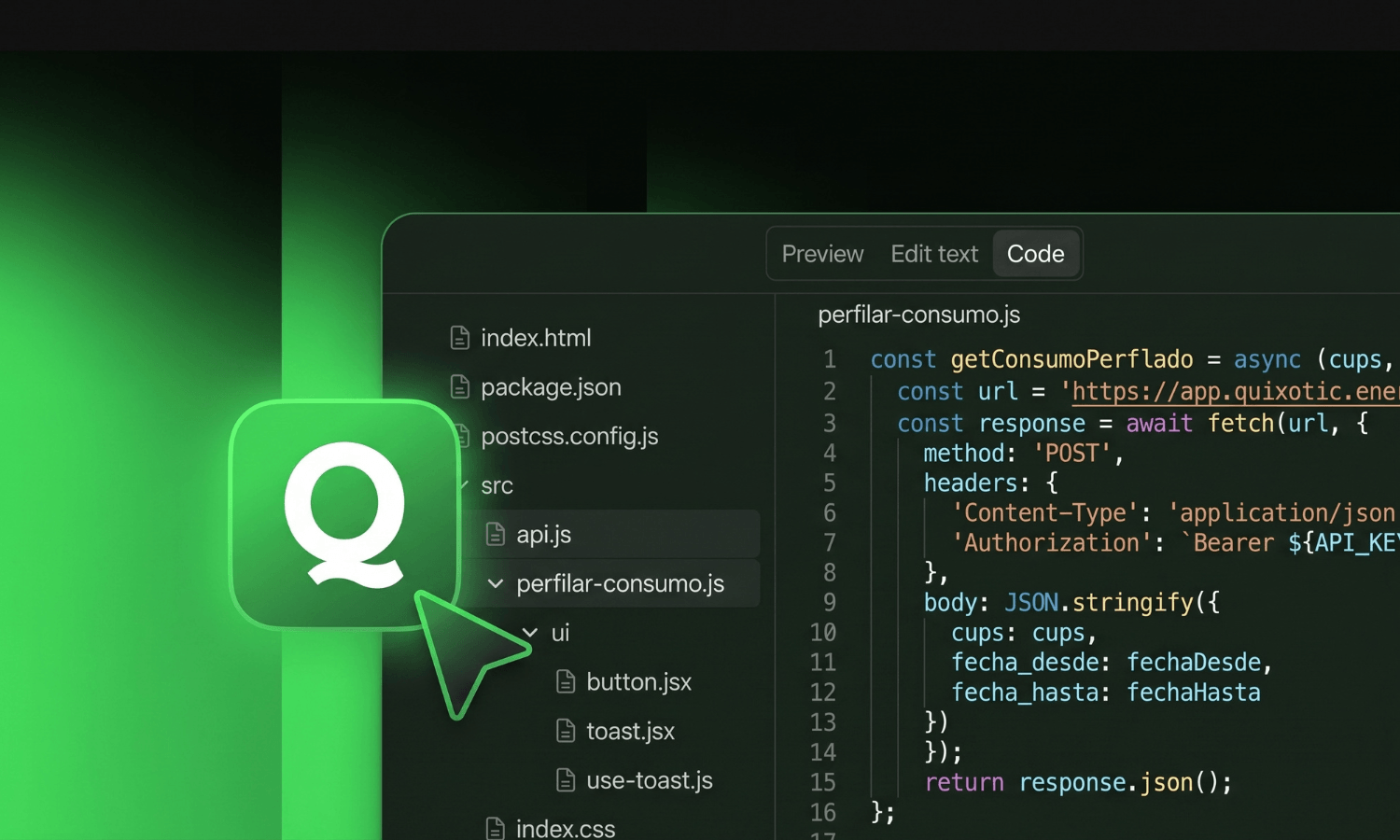
It needs two things, and neither is the AI. The first is an API with no second-class endpoints. QUIXOTIC had no user interface until 2023, so the API was built first and the front end after, and today that front end is just another client of the same API. Whatever can be done from a screen can be done through the API: every filter, every action, every button. There are no hidden functions reserved for the vendor's own application.
The second is documentation that does not go stale. An AI assistant codes well when it receives context that is correct, complete and current; with outdated documentation, it fills the gaps by guessing. In QUIXOTIC, every configuration change regenerates the API documentation automatically using AI, and new fields and entities are enabled in minutes, with no code and no ticket. The assistant works with the platform as it is today, not as it was six months ago.
What does the product and technology team gain?
For the people who design and maintain a supplier's tool ecosystem, there are five concrete advantages:
- The same API we use. Every feature we ship goes through the API our clients use. What you build on top does not depend on someone opening an endpoint for you: if the product can do it, so can you.
- Documentation that never goes stale. It is regenerated with every configuration change, so an integration that works today does not break because of outdated documentation, and the team does not need to ask the vendor which fields exist.
- Ready for vibe coding. Structured, current documentation lets an AI assistant build reliably. It is what a product manager with no engineering background did in the case that opens this article.
- Two versions, two uses. The v3 is designed for portals and your own apps; the v2, with an API key, for B2B and partner integrations. You choose by use case instead of being forced down a single route.
- Your stack, your rules. You can connect the tools you already have, such as CRM, ERP or BI, or build your own from scratch, without replacing anything to get started.
What does the operations and customer service team gain?
The change shows up in the daily work of the people who serve customers and manage the customer base:
- Every answer on one screen. Contracts, bills, arrears and payment status, live and inside the tools agents already use, with no jumping between systems to resolve a query.
- AI that reads real data. When a customer asks why their bill came out lower, an assistant with access to the API answers with the actual consumption rather than guesswork. The context is correct, complete and current, which is why the answer can be trusted.
- Build once, scale across. A single integration layer serves unlimited workflows, partners and channels. What is built for customer service is later reused for payment collection, onboarding or operational dashboards.
- Act, don't just look. Update bank details, send payment links or change tariffs. Every change is written back to the platform instantly, with no re-keying.
- Automate safely. The APIs include permissions, validation and audit trails, so automating does not mean taking on risk, and every action is recorded.
How do you get started, and what should you watch for?
For a supplier without a large engineering team, the starting point is to pick a specific, contained friction point, such as a single customer view or an arrears reminder with a payment link, and define precisely which data it needs and which actions it should be able to perform. It makes sense to start in a test environment with minimum permissions.
Vibe coding speeds up building, but it does not replace review. For tools that touch sensitive data or billing processes, it is reasonable to have someone with a technical profile review the generated code before putting it in the hands of the whole team. And for very large volumes of data, such as interval consumption data, there are dedicated export routes rather than one-off API queries.
The decisive profile, as the case at the start shows, is not an engineer but someone who knows the business in depth and knows what they want to solve. The question is no longer whether your team can build what it needs, but whether your platform lets it. If you would like to see what you could build on your own data, book a demo.
Frequently Asked Questions
What does it mean for energy supplier software to be API-first?
It means everything the platform does is available through an API, and the interface itself uses that same API. In QUIXOTIC, every feature is offered through the same API that clients use, with no reserved endpoints.
What is vibe coding in the energy sector?
It means creating tools by describing in natural language what you need and letting an AI assistant generate the code. In energy, it is used to build dashboards, portals, payment collection automations or customer service tools on top of supplier software, as long as the API and its documentation are reliable.
Can you do vibe coding without an engineering team?
Yes, for contained tools, as shown by a client whose product manager, with no engineering background, built a customer service platform on the QUIXOTIC API. For tools that handle sensitive data or billing, technical review and a test environment are recommended.
What is the difference between the QUIXOTIC v2 and v3 APIs?
The v3 is designed for portals and applications, and the v2, which works with an API key, for B2B and partner integrations.
Is it safe to build your own tools on the API?
QUIXOTIC APIs include permissions, validation and audit trails, so actions are recorded. Even so, it is best to test first in a controlled environment and limit each tool's permissions to the minimum needed.

Ernesto Puente: Chief Technology Officer in SaaS for Energy Markets


Stay connected to the future of EnergyTech
Subscribe to receive trends, news and our innovative tech articles directly to your inbox
Unsubscribe anytime. (See privacy policy)