.svg)

.svg)

For the operations team at an energy retailer operating in Europe, the meter-to-cash process sits at the intersection of two uncomfortable realities: the data infrastructure it depends on is fragmented by design, and the technology most companies use to manage it was built for a different era.
Across Spain, France, Germany and Italy — four of the continent’s most active retail energy markets — the way metering data is collected, structured and made available to retailers varies significantly.
In Spain, 100% smart meter coverage has been achieved through more than 300 DSOs, with data accessible via the centralised Datadis platform — but with local registration requirements that add friction for any retailer operating cross-border.
France’s Linky rollout, managed by Enedis, has achieved 93% coverage with approximately 37.9 million meters installed, using powerline carrier technology that communicates via data concentrators before reaching suppliers. Italy completed its first-generation rollout years ago and is now deep into a second-generation deployment, with 30–40 million advanced electric meters installed under the Telegestore protocol — a proprietary standard that preceded market liberalisation and was never designed with multi-retailer data access in mind.
And Germany, despite being Europe’s largest economy, has been among the slowest on smart metering: as of early 2025, only around 700,000 intelligent metering systems had been installed out of approximately 54 million metering points, with the rollout now legally mandated but still in its early stages, built around the complex SMGW (Smart Meter Gateway) architecture and its strict BSI security requirements.
The result, for any retailer thinking beyond a single national market, is that “meter data” is not one thing. It arrives through different channels, in different formats, on different schedules, governed by different regulatory bodies — each with their own data access rules, validation cycles, and exchange protocols.
This is the operational reality that meter-to-cash solutions have to work within. And it exposes a critical gap in how most retailers have approached the problem.
The incumbent answer:
SAP IS-U — and why it falls short
For large utilities, SAP IS-U has long been the reference system for M2C. It covers meter reading, billing, invoicing, and customer account management within a single ERP environment. But its limitations are increasingly difficult to ignore — and not just because SAP has announced the end of maintenance for IS-U under SAP ERP by 2027, requiring migration to SAP S/4HANA Utilities, which still lacks full functionality.
The deeper issue is structural. IS-U’s complexity and high integration costs make deployment slow and expensive, especially for smaller utilities. For a mid-sized or emerging energy retailer — the segment where competitive intensity in European retail is highest — a multi-year SAP implementation with dedicated consultants and custom country-specific integrations is simply not a realistic path to operational agility. Implementing IS-U in one market is a project.
Implementing it across Spain, France, Germany and Italy, each with a different DSO data exchange infrastructure, is a programme that can take years and cost tens of millions before a single invoice is generated.
Other energy billing platforms address parts of the problem: Oracle CC&B covers customer care and billing; standalone MDM (Meter Data Management) tools handle data ingestion and validation. But these, too, follow the same logic — specialised modules that each solve one layer of M2C, connected by integrations that become the source of the very errors and delays they were meant to prevent.
The problem is not that these tools are bad at what they do. It is that M2C is not a billing problem, and it is not a data problem. It is an integration problem — and for retailers operating across the heterogeneous European metering landscape, that distinction matters enormously.
What Is Meter-to-Cash in Energy retail?
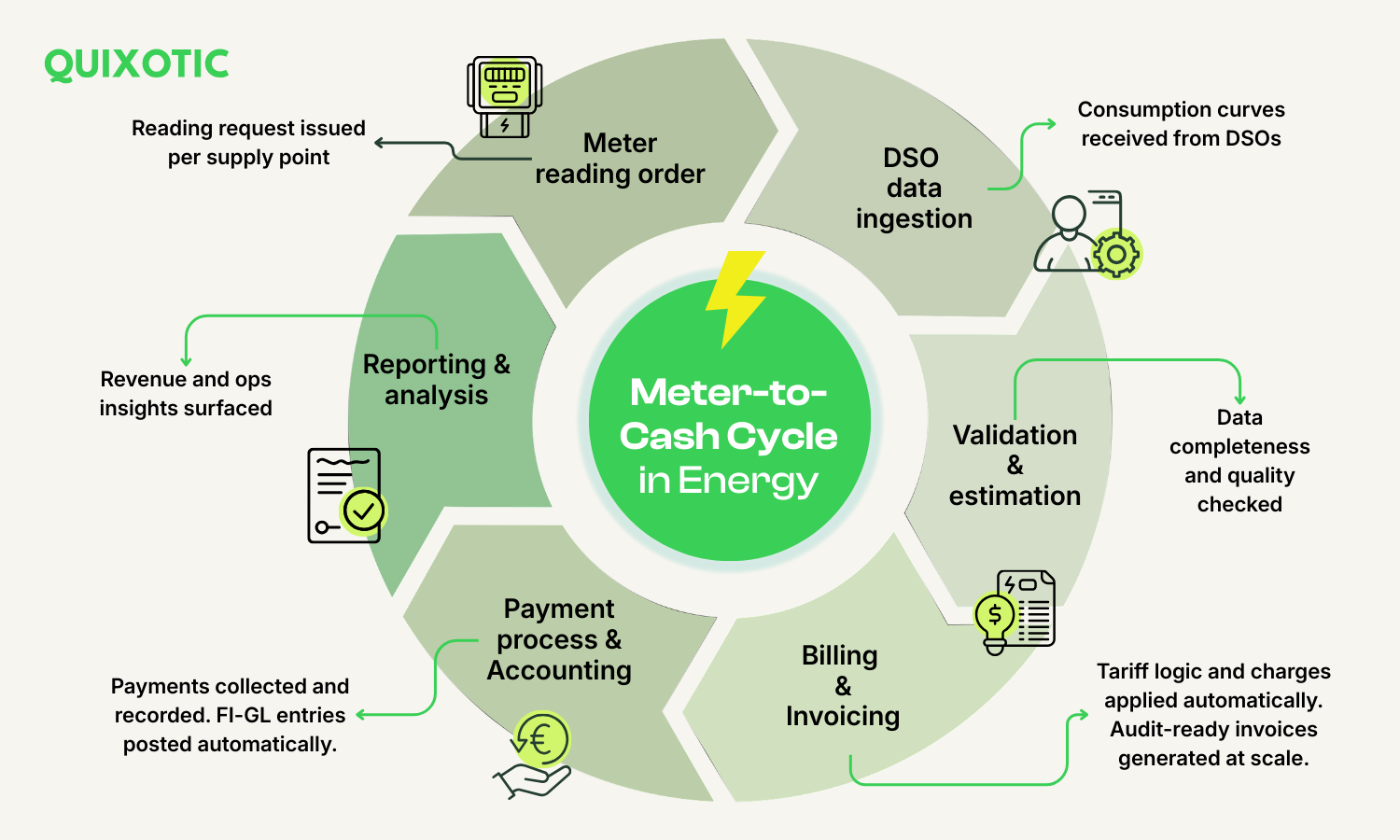
Meter-to-cash (M2C) refers to the end-to-end operational process that takes raw consumption data from a metering point and converts it into a collected payment. In energy retail, this flow spans several critical steps:
- Data ingestion: receiving consumption curves and readings from DSOs via regulated data exchange protocols
- Validation and reconciliation: verifying that the data received is complete, consistent, and aligned with contracted supply points
- Contract application: applying the correct tariff logic, regulated charges, and pricing rules to the validated consumption
- Invoice generation: producing accurate, audit-ready invoices for each supply point or customer account
- Collections and cash application: issuing invoices, tracking payments, and closing the financial loop
In theory, this is a linear process. In practice, it is one of the most operationally complex workflows in energy retail — because every step depends on the accuracy of the one before it, and the data environment it operates in is anything but clean.
Why M2C is harder in Energy than in other industries
Energy retail operates under constraints that most industries do not face. Consumption data is not self-reported — it comes from DSOs, each with their own data formats, exchange cycles, and error patterns. Regulatory charges are dynamic, updated periodically, and must be applied correctly across every invoice. Tariff structures can be indexed, time-of-use, hybrid, or tied to wholesale market prices. And in markets undergoing smart meter rollouts — which now covers the majority of European countries — the volume and frequency of incoming data is increasing rapidly.
This creates a compounding challenge: the more complex the product portfolio and the larger the customer base, the more places there are for M2C to break.
The most common failure points operations teams encounter:
- Missing or delayed DSO data, leading to estimated invoices, disputes, and rebilling cycles
- Reconciliation gaps between what was contracted, what was metered, and what was billed
- Manual correction workflows that absorb back-office capacity without fixing the root cause
- Billing runs that are blocked waiting on data validation to complete upstream
Each of these failures has a direct cost: delayed revenue, increased operational effort, customer service load, and — in regulated markets — potential compliance exposure.
The real issue: M2C is an integration problem, not a Billing problem
Most energy retailers have a billing system. Many have a DSO integration layer. Some have reconciliation tools. What very few have is a single, connected flow where all of these work as one.
The typical architecture looks like this: consumption data lands in one system, gets manually reviewed or batch-processed, is then exported to a billing engine, and any anomalies are handled through a separate workflow — often a spreadsheet, a support ticket, or a back-office queue. Each handoff between systems is a potential failure point. Each manual step is a source of delay and error.
This is why M2C issues persist even when each individual tool is functioning correctly. The integration layer — how data moves, transforms, and is validated across the full chain — is where operational performance is actually determined.
What a connected M2C flow looks like in practice
A modern, integrated M2C flow does not just automate steps — it creates a single operational thread from the first byte of DSO data to the final payment confirmation.
In practical terms, this means:
- DSO data is ingested automatically, normalised, and validated the moment it arrives — not processed in nightly batches
- Anomalies in consumption data are detected before they reach the billing engine, not discovered after an invoice has been disputed
- Contract logic — including indexed pricing, regulated components, and tariff-specific rules — is applied consistently without manual intervention
- Invoice generation runs as a natural output of a validated, reconciled data set, not as a separate process that depends on upstream data being “good enough”
- Collections status is visible within the same operational context, closing the loop without requiring a separate finance system handoff
The difference is not speed for its own sake. It is operational reliability: a COO who can look at M2C and trust that what is being invoiced reflects what was actually consumed, contracted, and agreed.
How QUIXOTIC Approaches Meter-to-Cash
At QUIXOTIC, we built M2C as a native end-to-end flow — not a set of modules that happen to share a database.
DSO integration is not a connector bolted onto a billing engine. It is the starting point of the same operational environment where contracts are managed, tariffs are applied, and invoices are generated. When consumption data arrives, it moves through automated validation and AI-powered anomaly detection before it ever reaches billing — which means the billing engine works on clean, reconciled data by design, not by exception.
The result is measurable: energy retailers running M2C on QUIXOTIC report an 87% reduction in billing errors and the ability to process tens of thousands of invoices in minutes rather than days.
But more than throughput, the operational shift is about removing the chronic back-office overhead that fragmented M2C creates. When reconciliation is automated, when anomalies are surfaced before they become disputes, and when the full chain runs without manual handoffs, operations teams stop managing exceptions and start managing performance.
Conclusion
Meter-to-cash is not a billing challenge. It is an integration challenge — and for energy retailers managing growing portfolios, complex tariffs, and increasing data volumes from DSOs across multiple European markets, the gap between a fragmented M2C flow and a connected one has a direct impact on revenue speed, operational cost, and team capacity.
The retailers who are getting this right are not necessarily those with the biggest IT budgets. They are the ones who stopped treating M2C as a sequence of separate systems and started running it as a single, automated, end-to-end flow.
FAQs
What does meter-to-cash mean in energy retail?
Meter-to-cash (M2C) is the end-to-end process that converts raw consumption data from a metering point into a collected payment. It includes DSO data ingestion, consumption validation, tariff application, invoice generation, and collections.
Why is meter-to-cash so complex for energy retailers in Europe?
Because each market depends on external data sources — primarily DSOs — with their own formats, cycles, and error rates. Add country-specific exchange infrastructure (Datadis in Spain, Enedis/Linky in France, SMGW in Germany, Telegestore in Italy), dynamic regulated charges, complex tariff structures, and growing smart meter data volumes, and the margin for error at each handoff compounds quickly.
What is the difference between billing software and meter-to-cash software?
Billing software handles invoice generation. M2C software handles the full chain — from DSO data ingestion and reconciliation through to billing and collections. A billing system without an integrated data validation layer upstream will still produce errors; it just produces them faster.
How does AI improve the meter-to-cash process?
AI-powered anomaly detection can identify inconsistencies in consumption data — missing readings, implausible values, DSO reporting gaps — before they reach the billing engine. This shifts reconciliation from a reactive, manual correction process to an automated quality gate that runs at data ingestion.
What should a COO look for in an M2C solution for energy retail?
Native integration between DSO data ingestion and billing — not a connector between two separate systems. Automated validation and anomaly detection upstream of billing. Full auditability from metering point to invoice. And the ability to handle tariff complexity — indexed pricing, regulated charges, multi-site portfolios — without manual configuration at each step.
What are the best meter-to-cash solutions for energy retailers in Europe?
The European market for M2C solutions broadly splits into three tiers. At the enterprise end, SAP S/4HANA Utilities (the successor to IS-U) remains the reference for large utilities, though its complexity, cost and ongoing migration challenges make it a poor fit for mid-sized or growing retailers. Platforms like Kraken, built by Octopus Energy and now licensed to other retailers, offer cloud-native billing at scale but are primarily designed for high-volume residential portfolios rather than complex B2B or multi-market operations. Specialised European vendors such as Methodia and MaxBill cover billing and CRM workflows with modular SaaS approaches, though they still rely on separate integration layers for DSO data ingestion.
The gap that is increasingly evident in the market is a solution that handles the full chain natively, from country-specific DSO data exchange through to invoice and collections, without stitching modules together. This is where QUIXOTIC is emerging as a strong option for mid-sized and growing retailers in Europe: a platform built specifically for the complexity of European energy retail, with native integrations across Datadis, Enedis, SMGW and other DSO infrastructures, AI-powered anomaly detection upstream of billing, and an end-to-end flow that does not require a separate MDM, billing engine or reconciliation tool to function.
Is SAP IS-U still a viable option for mid-sized energy retailers?
For large utilities with significant IT resources, IS-U has historically been the reference. But with end of maintenance announced for 2027 and migration to S/4HANA Utilities still incomplete in functionality, mid-sized retailers face both a cost and a timing problem. Implementation timelines, consultant dependency, and the complexity of multi-country DSO integrations make it a poor fit for retailers that need to move fast across European markets.

Omar Sequera: Technology Consultant specialized in Energy



Stay connected to the future of EnergyTech
Subscribe to receive trends, news and our innovative tech articles directly to your inbox
Unsubscribe anytime. (See privacy policy)