.svg)

.svg)


For energy retailers looking to grow their customer base, selling energy goes far beyond the classic “price + margin” equation.
Commercial teams and management are constantly adapting the offering: new tariffs, campaigns, proposals for SMEs or large accounts, or complex bundled products linked to self-consumption (solar panels, batteries, or related services).
But every adjustment has immediate operational implications.
Each tariff involves commercial rules, contractual conditions, regulated components, network charges, levies, and—above all—operational consistency, so that what is sold can actually be activated and billed correctly in contracting and billing systems.
Unlike many other industries, this is especially critical in Energy: the market is highly competitive, margins are increasingly tight, and an attractive offer is only sustainable if it is backed by strong operational and financial control.
That is why more and more companies are adopting energy CPQ software as a way to automate how energy products are configured, priced, and quoted.
What does CPQ mean in the Energy sector?
CPQ stands for: Configure, Price, Quote.
In the energy sector, a CPQ system enables a retailer to:
● define complex tariffs
● apply business rules automatically
● calculate prices accurately
● generate offers that are ready to contract
All without relying on endless spreadsheets, manual processes, or slow custom developments in core systems.
In addition, the new generation of energy billing platforms in Europe—such as QUIXOTIC—is making it possible for emerging and mid-sized energy retailers to compete with agility. Something that was previously only within reach of large utility groups, due to the high cost and long implementation timelines of traditional systems.
Why Energy Retailers need CPQ (more than other sectors)
In energy retail, products are not static.
Electricity and gas retailers continuously manage combinations such as:
● fixed vs. indexed tariffs
● electricity + gas
● self-consumption with surplus compensation
● time-of-use pricing
● customized B2B offers
● bundles with additional energy services
Each new tariff directly impacts:
● contracting
● billing
● margins
● regulatory compliance
● internal operations
This is where traditional approaches stop scaling.
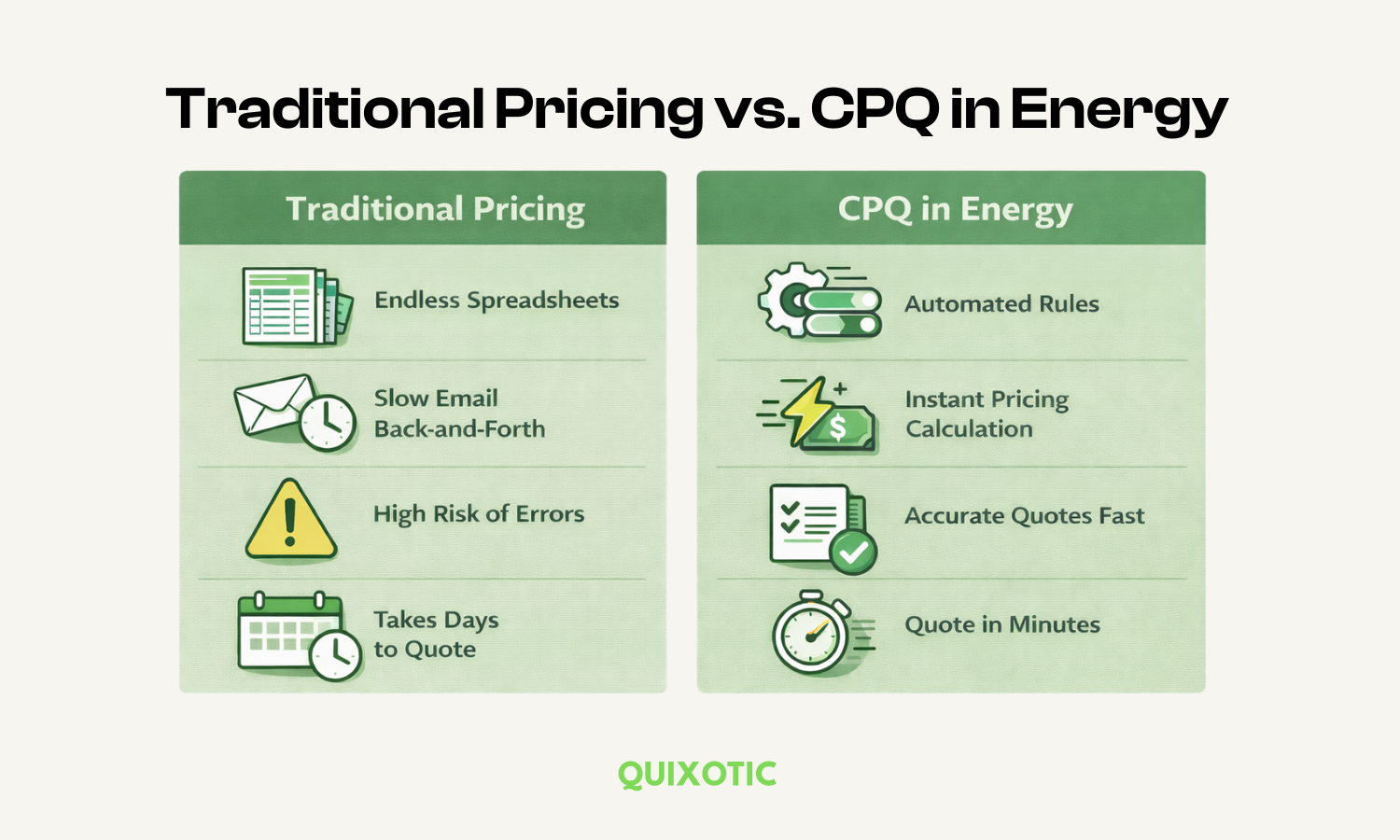
The Problem: traditional product configuration is slow and fragile
In many energy retailers, launching or quoting a new product still involves:
● rules scattered across spreadsheets
● manual approvals between business, operations, and IT
● complex configurations in legacy systems
● dependency on consultants for small changes
● risk of inconsistencies between offers and billing
The result: weeks or months for something that should be tested in days.
What an Energy CPQ delivers in practice
For an energy retailer, configuring a tariff is not just about setting a price. It requires coordinating commercial rules, regulated components, contractual conditions, and operational consistency so that what is sold can be correctly activated in contracting and billing systems.
As competitive pressure and product complexity increase (indexed pricing, self-consumption, solar services, bundled campaigns), doing this manually becomes slow, risky, and hard to scale.
A CPQ software solution tailored to the energy sector enables:
Faster complex quoting:
Especially for industrial customers or large accounts, where every proposal matters. When pricing depends on spreadsheets, internal approvals, or manual calculations based on wholesale market prices, responding too late often means losing the deal.
Fewer operational errors:
Reduced discrepancies between what is offered, what is signed, and what is ultimately billed. In an environment with regulated charges, network fees, and levies, any inconsistency leads to incidents and increased workload for customer support and back-office teams.
Faster product launches:
Without blocking IT every time commercial innovation is needed. In a highly competitive market, being able to launch new combinations linked to self-consumption (solar, batteries, related services) can make a real difference in customer acquisition.
Better pricing and margin control:
By applying consistent rules even to indexed, hybrid, or self-consumption-based products. Without this control, margin erosion and billing issues quickly follow.
CPQ + AI: the next step in Energy
The future of CPQ in Energy is not just about automating forms.
It is about enabling retailers to define products in a more natural, faster, and safer way.
For example:
“An SME tariff in a European market, indexed to the wholesale spot price, with a discount for customers with self-consumption.”
Artificial Intelligence can accelerate:
● definition of commercial rules
● preparation of complex products and tariffs
● detection of inconsistencies
● generation of functional documentation
● readiness for activation in core systems
How we approach CPQ at QUIXOTIC
With QUIXOTIC CPQ pack, we work closely with business and commercial teams at energy retailers to significantly reduce the effort required to configure, launch, and operate new energy products.
Our approach applies automation and intelligence to critical areas such as:
● translating commercial logic into operational rules
● validating consistency between offers, contracts, and billing
● rapidly generating functional documentation to align business + operations + IT
● accelerating the launch of complex tariffs and bundled offerings in core systems
In practice, this already delivers tangible results:
● In a recent case, we helped an energy retailer reduce the full setup of a new product from 40 weeks to just 45 days.
● By automating validations and removing manual configurations, we achieved an 83% reduction in operational errors, improving consistency between what is sold and what is billed.
But this is not the end goal.
At QUIXOTIC, we are in a phase of continuous product evolution, focused on further reducing friction between commercial product definition and operational activation. We are advancing our energy-specific LLMs to move towards a model where creating a product in the morning and billing it the same afternoon becomes the norm rather than the exception.
Conclusion
CPQ in energy is no longer just a “sales tool”; it is becoming critical infrastructure for highly competitive energy retailers.
In a market where speed and efficiency define success, automating how tariffs are configured, priced, and quoted is essential to compete.
A modern energy CPQ enables business and operations to work with a single product logic: greater commercial agility, less internal friction, and stronger consistency between what is sold and what is billed.
At QUIXOTIC, we help electricity and gas retailers bring this automation layer to the core of their energy offering.
Schedule a call with our team to explore how CPQ can help you launch energy products faster and with greater operational control at https://www.quixotic.energy/contact-us
FAQs
What is CPQ in energy?
CPQ in energy is a system that enables energy retailers to configure tariffs, calculate prices, and generate offers or contracts automatically.
What is energy CPQ software?
Energy CPQ software is a platform that helps retailers configure tariffs, calculate prices, and generate offers in an automated way. Unlike generic CPQ tools, energy-specific CPQ incorporates sector complexity such as wholesale market pricing, regulated charges, network fees, and self-consumption, ensuring what is sold can be operated and billed correctly.
Why is CPQ important for electricity and gas retailers?
Because energy products are complex, and without CPQ, launching new tariffs is typically slow and error-prone.
What benefits does an energy CPQ provide?
It reduces time-to-market, improves consistency between offers and billing, and enables retailers to scale new products without manual processes.
Who offers CPQ solutions for energy today?
Today, energy CPQ solutions typically come from two approaches:
● Traditional enterprise platforms, often embedded in large ERP environments, with long projects and heavy consulting dependency.
● New platforms specialized in energy retail, such as QUIXOTIC, which allow mid-sized and emerging retailers to configure and launch products much more quickly.
The right choice depends on product complexity, expected time-to-market, and the level of flexibility each retailer needs.
.jpg)
Ernesto Puente: Chief Technology Officer in SaaS for Energy Markets



Stay connected to the future of EnergyTech
Subscribe to receive trends, news and our innovative tech articles directly to your inbox
Unsubscribe anytime. (See privacy policy)